
Development of Integrated Instrument Components of Chemistry Practicum for Acid-Base & Organic Reaction Topics with Green Chemistry Approach
Published 2025-07-07
Keywords
- Integrated Instrument Components,
- Green Chemistry,
- Acid-Base,
- Organic Reaction
How to Cite



Abstract
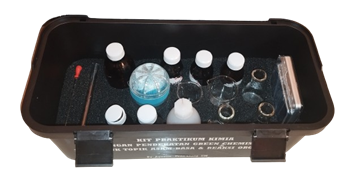
Chemistry is a practical subject, not only studied through textbooks but also through practicums. However, practical activities are rarely carried out in schools. This is due to several factors, such as the unavailability of a laboratory, inadequate practical manuals, and the emergence of practical waste, which is dangerous for the environment. This research aims to develop an integrated instrument component (KIT) for chemistry practicum with a green chemistry approach for acid-base & organic reactions and determine its suitability. The research and development (R&D) method used in this research is the 4D model proposed by S. Thiagarajan, Dorothy S. Semmel and Melvyn I., which contains four stages: definition, design, development and dissemination. Due to limited research capabilities and time, this research could only reach the development stage, namely validation testing, carried out by Chemistry Lecturers at the State University of Malang and Chemistry Teachers at SMAN 1 Pasirian. The results of this research are an integrated instrument component product (KIT) for chemistry practicum, which contains a toolbox and materials and a practicum guide that includes educational videos. The average percentage of media validation results for this practicum's integrated instrument components (KIT) reached 92.33%, with a very feasible category. The students' positive response to the practicum integrated instrument (KIT) component with an average percentage of 90.97% with excellent criteria. It is hoped that the results of this development can become an alternative medium for learning chemistry that makes it easier for students to master chemistry material, especially on the topics of acid-base and organic reactions.