
Introduce-Operate-Network (ION) Model: A Teaching Innovation on Formula Writing and Naming of Compounds in Chemistry
Published 2025-05-10
Keywords
- ADDIE model,
- chemistry,
- compound naming,
- formula writing,
- ION learning model
How to Cite



Abstract
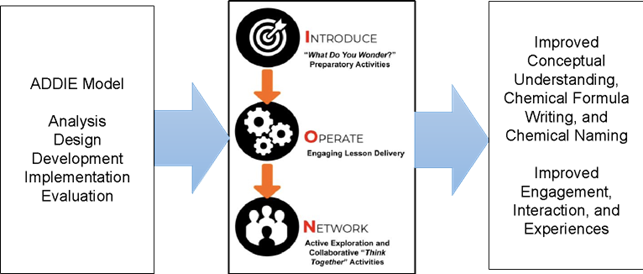
Chemistry education poses significant challenges, particularly in grasping fundamental concepts like formula writing and compound nomenclature. The complexities involved, such as confusion between valency and oxidation numbers, underscore the need for innovative teaching approaches. To address this, the researchers designed, developed, implemented, and evaluated an Introduce-Operate-Network (ION) learning model, integrating visual, interactive, and collaborative elements. The expert assessment confirmed the model's content validity, with a highly acceptable score of 4.93. Reliability testing demonstrated its effectiveness in assessing student performance, with Cronbach's alpha values of 0.890 for concept tests and 0.726 for student feedback surveys. Implementation with sixty Grade 12 students revealed substantial gains, with the experimental group outperforming the control group significantly. The experimental group achieved a mean increase of 8.90, compared to 0.37 for the control group. Statistical analysis confirmed these findings, with significant improvement within each group (control group: t(29)=0.52, p=.602; experimental group: t(29)=11.80, p=.000) and a significant difference in mean gains between groups (t(58)=8.32, p=.000) with a strong effect size (Cohen's d=2.15). Thematic analysis of student experiences highlighted the efficacy of the ION learning model in facilitating step-by-step learning, though challenges were noted. The ION learning model emerged as a powerful tool for enhancing student understanding of formula writing and compound naming. Future research endeavors should focus on refining the model and exploring its broader applicability in science education.