
Artisanal Sunflower Oil: Nutritional Quality, Fatty Acid and Trace Element Profiles, Oxidative Stability, and Non-Carcinogenic Risk Assessment
Published 2025-12-08
Keywords
- Fatty acid profile,
- Physicochemical properties,
- Oxidative stability,
- Trace elements,
- Health risk assessment
- Vegetable oils ...More
How to Cite



Abstract
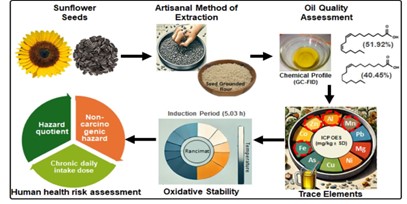
This study aimed to produce sunflower oil using an artisanal cold-pressed method and to evaluate its nutritional quality, physicochemical properties, fatty acid composition, mineral profile, and potential non-carcinogenic health risks. The oil contained a high proportion of unsaturated fatty acids, dominated by linoleic (51.92%) and oleic acids (40.45%), and exhibited favorable lipid nutritional indices (AI 0.03; TI 0.13; H/H 29.76). Physicochemical parameters, including low acidity and peroxide values, complied with Codex Alimentarius standards and indicated minimal oxidative degradation. UV-vis spectroscopy revealed characteristic absorption bands to tocopherols, carotenoids, sterols, and unsaturated fatty acids. Oxidative stability (5.03 h) was comparable to values reported for conventional cold-pressed sunflower oils. Four trace elements were detected in decreasing order (Zn > Fe > Al > Mn), all within FAO/WHO and DRI limits, except for slightly elevated Zn for children. Non-carcinogenic risk assessment (HQ and HI < 1) indicated no adverse health risk for consumers aged 8, 18, 30 years. Overall, the artisanal oil demonstrated high nutritional value, acceptable mineral levels, and a favorable safety profile.