
Published 2026-07-01
Keywords
- Bioplastic,
- Polylactic acid,
- Waste recovery
Copyright (c) 2026 Orbital: The Electronic Journal of Chemistry

This work is licensed under a Creative Commons Attribution-NonCommercial-NoDerivatives 4.0 International License.
How to Cite



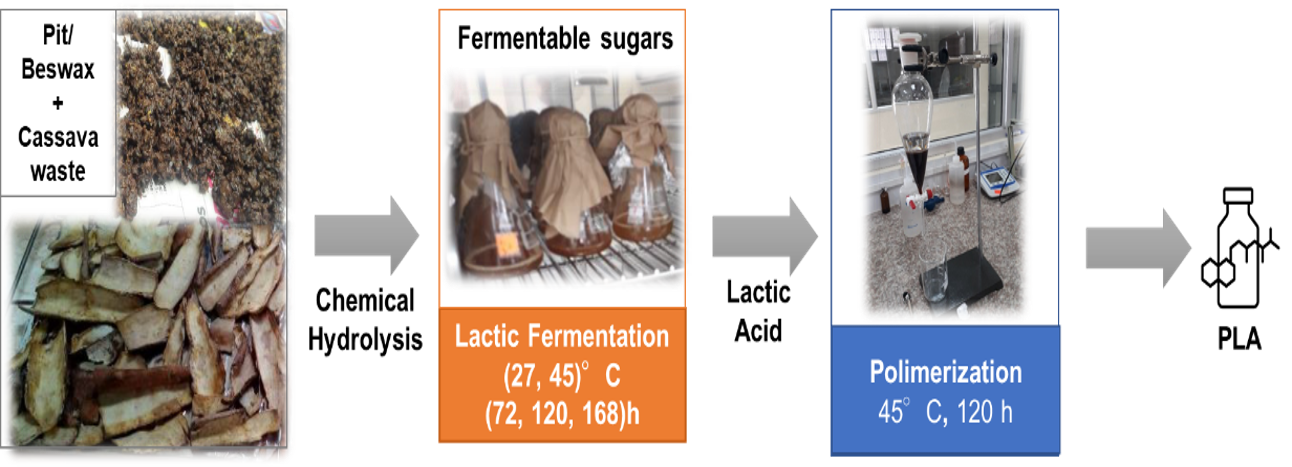
Abstract
Global agricultural production generates a wide variety of valuable waste. In a world seeking to become increasingly sustainable, it is necessary to take advantage of these resources by establishing processes based on the bioeconomy and the circular economy. Cassava waste and beeswax were used to obtain polylactic acid (PLA). The fermentable sugars were extracted from each residue using a chemical hydrolysis process. Lactic fermentation using a commercial strain and with a multiple factorial design was carried out to evaluate the type of residue (cassava peel, pit, cassava peel-pit mixture), temperature (27 and 45°C), and reaction time (72, 120, 168 hours). The process involved oligomerization and ring-opening polymerization (ROP) to obtain PLA. The highest amount of LA was 2618.81 mg/L when working with a mixture of cassava peel and stone during 120 hours of fermentation at 45°C. During polymerization, 70.05% of the obtained material corresponded to PLA, and through thermal analysis, were determined: Glass transition temperature (Tg = 91.81 °C), melting temperature (Tm = 178.77 °C), and degradation temperature (Td = 286.09 °C). Although the characteristics of the obtained material still differ from those reported for commercial PLA, the study revealed that the selected waste is a potential resource for producing a biopolymer.