Competitiveness in the travel and tourism sector: case study on Chaves, Vila Real, Portugal
Abstract
This research note presents a situational analysis of the Municipality of Chaves, District of Vila Real, located in the North of Portugal. The area covered by the research is the statistical sub-region NUT III – Alto Tâmega, in the Northern Region of Portugal, in accordance with Law nº 75, of September 12, 2013. The local economy of Chaves is traditionally characterized by agricultural production and, more recently, by Thermal and Rural Tourism. It is a region rich in history and cultural traditions. There are two socioeconomic challenges to be faced: the aging of the resident population and the emigration of the younger population. In this sense, tourist activity can be configured as a vector for the economic development of the Alto Tâmega and Barroso region, which covers an area of approximately 2,922 km² and comprises the municipalities of Boticas, Chaves, Montalegre, Ribeira de Pena, Valpaços and Vila Pouca de Aguiar. According to the 2021 census, the resident population of Alto Tâmega and Barroso is 84,248 inhabitants.
Downloads
References
AMAT (2024). Associação de Municípios do Alto Tâmega. Caracterização. https://www.amat.pt/caracterizacao/
CCDR-N (2020). Comissão de Coordenação e Desenvolvimento Regional do Norte. Programa Operacional Regional do Norte 2021-2027. https://www.ccdr-n.pt/pagina/norte2030
Chaves. Município (2024). https://www.chaves.pt/pages/2
Creswell, J. W. (2010). Projeto de pesquisa: métodos qualitativo, quantitativo e misto. Porto Alegre: Artmed.
INE. Instituto Nacional de Estatística (2021). Portugal. Censos 2021. https://censos.ine.pt/xportal/xmain?xpgid=censos21_main&xpid=CENSOS21&xlang=pt
Martins, G. A., & Theóphilo, C. R. (2007). Metodologia da Investigação Científica para Ciências Sociais Aplicadas. São Paulo: Atlas.
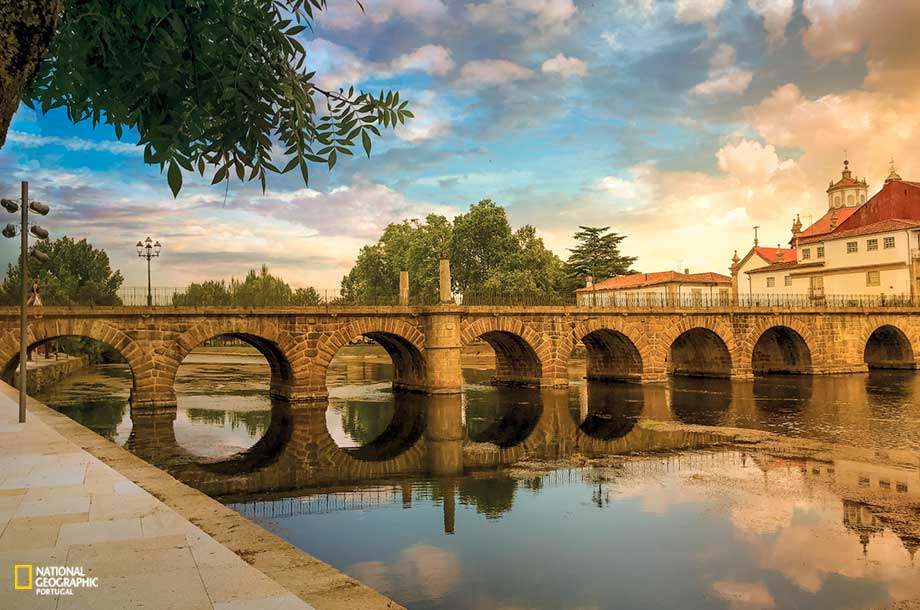
National Geographic. (2024). Ponte de Trajano: ode às Ninfas. https://content.nationalgeographic.pt/medio/import/attachment/edicoesespeciais/VIAGENS/PonteTrajano/p1.jpg
Norte 2030. Programa Regional do Norte. (2024). Aviso NORTE2030-2024-50: Sistema de Incentivos de Base Territorial (IT) – CIM Alto Tâmega e Barroso. https://cimat.pt/wp-content/uploads/2024/10/Aviso_SI-Base-Territorial_IT_Vf_Alto-T%C3%A2mega.pdf
Portugal. Lei nº 75, de 12 de setembro de 2013. https://diariodarepublica.pt/dr/legislacao-consolidada/lei/2013-56366098-56359576
Raupp, F. M., & Beuren, I. M. (2006). Metodologia da pesquisa aplicável às ciências sociais. In. Beuren, I. M. (Org.). Como elaborar trabalhos monográficos em contabilidade: teoria e prática. São Paulo: Atlas.
Santos, A. F. L. (2015). Competitividade no setor de viagens e turismo: estudo de casos múltiplos na Região Metropolitana da Baixada Santista. Dissertação (Mestrado em Hospitalidade)– Universidade Anhembi Morumbi, São Paulo.
Santos, A. F. L. (2020). Relações de Hospitalidade e Hostilidade dos stakeholders do Poder Público no setor de viagens e turismo. Tese (Doutorado em Hospitalidade)– Universidade Anhembi Morumbi, São Paulo.
TDP. Turismo de Portugal. Estratégia Turismo 2020-2027. (2017]). https://www.turismodeportugal.pt/SiteCollectionDocuments/estrategia/estrategia-turismo-2027.pdf
Yin, R. K. (2015). Estudo de Caso: planejamento e métodos. Porto Alegre: Bookman.

Authors/researchers who publish in Ateliê do Turismo accept the following terms:
1 - Copyright:
Authors/researchers retain their copyright, but grant Ateliê do Turismo non-exclusive exploitation rights (reproduction, distribution and publicity). They grant Ateliê do Turismo the right of first publication of their work/research, which will be simultaneously subject to the license indicated in point 2. Authors may establish other additional agreements for the non-exclusive distribution of the version of the work published in Ateliê do Turismo, provided that their initial publication in this journal is acknowledged.
2 - License.

This work is licensed under a CC BY 4.0
You are free to:
- Share — copy and redistribute the material in any medium or format for any purpose, even commercially.
- Adapt — remix, transform, and build upon the material for any purpose, even commercially.
- The licensor cannot revoke these freedoms as long as you follow the license terms.
Under the following terms:
- Attribution — You must give appropriate credit , provide a link to the license, and indicate if changes were made . You may do so in any reasonable manner, but not in any way that suggests the licensor endorses you or your use.
- No additional restrictions — You may not apply legal terms or technological measures that legally restrict others from doing anything the license permits.