
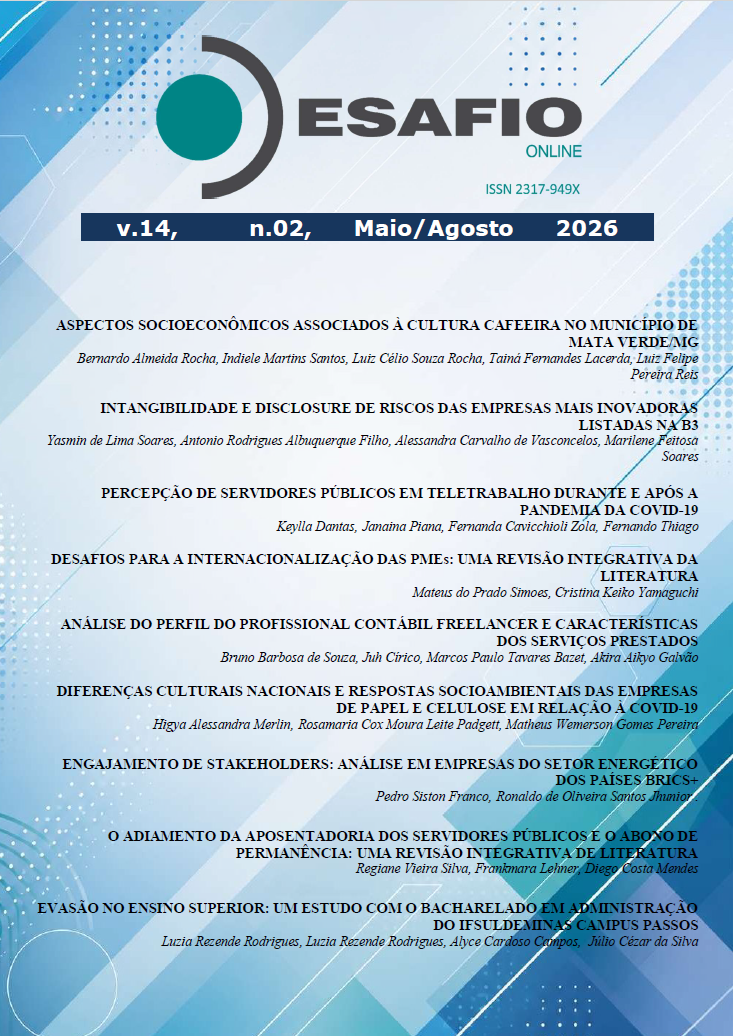
STAKEHOLDER ENGAGEMENT: AN ANALYSIS OF ENERGY SECTOR COMPANIES IN BRICS+ COUNTRIES
DOI:
https://doi.org/10.55028/7m5z3h24Keywords:
Stakeholder Engagement, BRICS+, Content AnalysisAbstract
The relationship between companies and stakeholders in BRICS+ countries is influenced by distinct economic and sociopolitical factors. This study aims to expand the understanding of Stakeholder Theory by investigating stakeholder engagement practices and prioritizations in the energy sector of these nations, considering the recent expansion of the bloc. The research problem focuses on variations in stakeholder engagement practices among energy sector companies. The objective is to analyze and compare these practices, evaluating different levels of engagement and stakeholder prioritization in each national context. Using an exploratory approach based on content analysis, non-financial reports from companies were examined with the support of NVivo software. The results reveal significant differences: companies in China and Russia emphasize informational engagement, prioritizing government and community; in Brazil, there is a balance between engagement levels, reflecting both state and market influence; South Africa follows a similar pattern. This study contributes to the literature by providing a comparative analysis of stakeholder engagement strategies in BRICS+ countries, highlighting the need for adaptations according to the specific characteristics of each country.
References
Araujo, M. M. D., Jhunior, R. O. S., Uchoa, M. T., & Boaventura, J. M. G. (2024). Value distribution to stakeholders: A study on power and strategic importance on the Toronto Stock Exchange. Revista de Administração de Empresas, 64, e2023-0116.
Bridoux, F., & Stoelhorst, J. W. (2014). Microfoundations for stakeholder theory: Managing stakeholders with heterogeneous motives. Strategic Management Journal, 35(1), 107-125.
Bridoux, F., & Stoelhorst, J. W. (2022). Stakeholder theory, strategy, and organization: Past, present, and future. Strategic Organization, 20(4), 797-809.
Carletti, A. (2013). A China, os BRICS e os países em desenvolvimento. Carta Internacional, 8(2), 20-37.
Clarkson, M. E. (1995). A stakeholder framework for analyzing and evaluating corporate social performance. Academy of Management Review, 20(1), 92-117.
de Melo, V. P., Taumaturgo, Í., & Jhunior, R. D. O. S. (2020). The concept of justice in stakeholder theory: A systematic literature review. Base Revista de Administração e Contabilidade da UNISINOS, 17(3), 429-455.Andriof, J., Rahman, S. S., Waddock, S., & Husted, B. (2002). Introduction: JCC theme issue: Stakeholder responsibility. The Journal of Corporate Citizenship, 16-19.
Dias, G. N., Hamza, K. M., Lievens, A., & Moons, I. (2025). Sustainability‐based value creation within a multi‐stakeholder network: Balancing expectation conflicts within the Amazon context. Business Strategy and the Environment, 34(1), 116-128.
Fainshmidt, S., Judge, W. Q., Aguilera, R. V., & Smith, A. (2018). Varieties of institutional systems: A contextual taxonomy of understudied countries. Journal of World Business, 53(3), 307-322.
Freeman, R. E. (1984). Strategic management: A stakeholder approach. Cambridge University Press.
Freeman, R. E. (2017). The new story of business: Towards a more responsible capitalism. Business and Society Review, 122(3), 449-465.
Garcia, A. S., Mendes-Da-Silva, W., & Orsato, R. J. (2017). Sensitive industries produce better ESG performance: Evidence from emerging markets. Journal of Cleaner Production, 150, 135-147.
Global Reporting Initiative (GRI). (2016). The GRI Standards: The global standards for sustainability reporting. Global Reporting Initiative.
Global Reporting Initiative (GRI). (2021). A short introduction to the GRI standards. Global Reporting Initiative.
Góes, H. A. A., Fatima, G., Santos Jhunior, R. O., & Boaventura, J. M. G. (2023). Managing for stakeholders towards corporate environmental sustainability. Corporate Social Responsibility and Environmental Management, 30(4), 1561-1572.
Gouvea, R., & Gutierrez, M. (2023). “BRICS Plus”: A new global economic paradigm in the making? Modern Economy, 14(5), 539-550.
Greenwood, M. (2007). Stakeholder engagement: Beyond the myth of corporate responsibility. Journal of Business Ethics, 74, 315-327.
Grushina, S. V. (2017). Collaboration by design: Stakeholder engagement in GRI sustainability reporting guidelines. Organization & Environment, 30(4), 366-385.
Harrison, J. S., Bosse, D. A., & Phillips, R. A. (2010). Managing for stakeholders, stakeholder utility functions, and competitive advantage. Strategic Management Journal, 31(1), 58-74.
Jhunior, R. O. S., Uchôa, M. T., Olar, A. I., & Boaventura, J. M. G. (2024). Distribuição de valor para stakeholders: percepções de empresas de capital aberto dos EUA. Revista Ciências Administrativas, 30, 1-17.
Jones, T. M. (1995). Instrumental stakeholder theory: A synthesis of ethics and economics. Academy of Management Review, 20(2), 404-437.
Krippendorff, K. (1980). Validity in content analysis. In Mochmann, E. (Ed.), Computer Strategies for Communication Analysis (pp. 69–112). Campus.
Krippendorff, K. (2018). Content analysis: An introduction to its methodology (4th ed.). Sage Publications.
Kujala, J., Lehtimäki, H., & Freeman, E. R. (2019). A stakeholder approach to value creation and leadership. In Leading change in a complex world: Transdisciplinary perspectives.
Kujala, J., Sachs, S., Leinonen, H., Heikkinen, A., & Laude, D. (2022). Stakeholder engagement: Past, present, and future. Business & Society, 61(5), 1136-1196.
Langrafe, T. D. F., Barakat, S. R., Stocker, F., & Boaventura, J. M. G. (2020). A stakeholder theory approach to creating value in higher education institutions. The Bottom Line, 33(4), 297-313.
Mahajan, R., Lim, W. M., Sareen, M., Kumar, S., & Panwar, R. (2023). Stakeholder theory. Journal of Business Research, 166, 114104.
Menezes, D. C., Vieira, D. M., & De Oliveira, J. E. (2022). Teoria dos stakeholders: sua evolução e agenda de pesquisa. Revista Ibero-Americana de Estratégia, 21(1), e18882-e18882.
Mitchell, R. K., Agle, B. R., & Wood, D. J. (1997). Toward a theory of stakeholder identification and salience: Defining the principle of who and what really counts. Academy of Management Review, 22(4), 853-886.
Ortas, E., Gallego‐Álvarez, I., & Alvarez, I. (2019). National institutions, stakeholder engagement, and firms' environmental, social, and governance performance. Corporate Social Responsibility and Environmental Management, 26(3), 598-611.
Peng, N. (2022). Great power conflict fuels BRICS expansion push. The Diplomat. Retrieved from https://www.thediplomat.com.
Ribeiro, H. C. M. (2025). Environmental, social and governance: comportamento e perfil na academia brasileira. Desafio Online, 13(1).
Santos, P. S., de Azevedo, D. B., & Malafaia, G. C. (2022). Reflexões sobre o alcance da governança colaborativa, a partir dos diálogos entre os stakeholders, no âmbito dos objetivos do desenvolvimento sustentável. Desafio Online, 10(3).
Stocker, F., De Arruda, M. P., De Mascena, K. M., & Boaventura, J. M. (2020). Stakeholder engagement in sustainability reporting: A classification model. Corporate Social Responsibility and Environmental Management, 27(5), 2071-2080.
Sulkowski, A. J., Edwards, M., & Freeman, R. E. (2018). Shake your stakeholder: Firms leading engagement to cocreate sustainable value. Organization & Environment, 31(3), 223-241.
Tolmasquim, M. T. (2012). Perspectivas e planejamento do setor energético no Brasil. Estudos Avançados, 26, 247-260.
United Nations Conference on Trade and Development (UNCTAD). (2023). BRICS investment report. Geneva: United Nations.
Valentinov, V., Santos Jhunior, R. O., & Góes, H. A. A. (2025). Corporate Environmental Sustainability Via Stakeholder Collaboration: Insights from Classical Institutional Economics. Journal of Business Ethics, 1-18.
Zhang, Y. (2022). Explaining Chinese SOEs’ risk tolerance in the developing world: Evidence from Chinese hydropower investment in Cambodia. World Development Perspectives, 28, 3-24.
Downloads
Published
Issue
Section
License
POLÍTICA DE DIREITOS AUTORAIS E CONFLITO DE INTERESSES
A Revista Desafio Online (DOn) baseia suas políticas éticas e normas nas diretrizes apresentadas pelo Comimittee on Publication Ethics – COPE (https://publicationethics.org/), em razão de seu compromisso com a qualidade editorial e ética científica.
Dever dos editores e equipe editorial:
- Decidir quais serão os artigos avaliados, baseados em sua qualidade, relevância acadêmica, conteúdo e adequação às diretrizes de submissão, sem discriminar, nenhum autor, por gênero, sexo, raça, orientação sexual, pensamento político, afiliação institucional, religião, naturalidade, nacionalidade, identidade étnico-cultural, ou outra forma de distinção social.
- Decidir e se responsabilizar pelos trabalhos que serão publicados (editor-chefe) seguindo as normas da política editorial, bem como os requisitos legais em vigor, no que se refere ao plágio, violação de direitos autorais e difamação.
- Não divulgar dados dos trabalhos além dos autores, pareceristas e membros do conselho editorial, zelando pela confidencialidade das informações.
- Não utilizar, ou se apropriar, do conteúdo original dos trabalhos submetidos, ainda não publicados.
- Não acompanhar o processo editorial do artigo em caso de existência de conflitos de interesses.
- Garantir que as submissões passem pelo processo de revisão duplo-cega (double-blind), sendo avaliado por, no mínimo, dois pareceristas.
- Atender aos princípios de boas práticas e transparência, averiguando condutas contrárias a estes, apresentando providências adequadas.
Dever dos pareceristas ad hoc:
- Auxiliar o corpo editorial, e os autores, no que tange a escolha das decisões editoriais, realizando a revisão sem qualquer tipo de distinção política, cultural, ou social, dos autores.
- Cumprir o prazo de resposta e data limite da avaliação, comunicando os editores nos casos de impossibilidade de realizar o trabalho.
- Abster-se de realizar a avaliação quando pouco capacitados ou não aptos, sobre o conteúdo do artigo. O declínio também deve ocorrer, na existência de qualquer conflito de interesses existente, por parte do avaliador.
- Respeitar o sigilo dos arquivos recebidos, sem que sejam divulgados, expostos ou conversados os conteúdos dos artigos, sem a permissão do editor-chefe, existindo a necessidade. O conteúdo dos trabalhos não deve ser utilizado para benefício próprio.
- Seguir os critérios de avaliação estipulados nas diretrizes, recomendando ajustes e melhorias, sem nunca realizar críticas ou ataques pessoais aos autores.
- Indicar referências de materiais adicionais que sejam pertinentes ao tema.
- Comunicar, aos editores, a existência de publicações anteriores, do mesmo trabalho.
- Os revisores serão incluídos na lista de pareceristas da Revista Desafio Online (DOn). Havendo a solicitação, eles podem receber uma Declaração de Avaliação formal, do Editor-Chefe. Para isso devem informar o nome completo e CPF, por e-mail.
Dever dos autores:
- Apresentar relatos precisos das submissões, com detalhes e referências necessárias à replicação, por terceiros. Dados implícitos devem ser precisamente apresentados, no artigo. Afirmações propositalmente incorretas, ou deturpadas, são tidas como má conduta ética, sendo inadmissíveis.
- Responsabilizar-se pela elaboração do material submetido, devendo o mesmo ser original, resguardando a autenticidade do conteúdo.
- Informar, através de citações adequadas, fontes de ideias e informações derivadas de outros trabalhos, evidenciando-as nas referências. A apropriação indevida de informações e trechos de trabalhos anteriormente publicados, sem a citação da fonte, se caracteriza como plágio e, nesses casos, o periódico se reserva o direito de rejeitar o trabalho, considerando tal prática antiética e inadmissível.
- Não submeter trabalhos que possuam, de forma substancial, a mesma investigação, para outros periódicos, ou mesmo que já tenha sido, anteriormente, publicado. Trabalhos publicados, anteriormente, em congressos serão aceitos para publicação apenas em caso de parcerias Fast Track com o evento. Artigos derivados de trabalhos de conclusão de curso, dissertações ou teses serão aceitos apenas mediante a inexistência de publicações em outros periódicos ou eventos, devendo, o autor principal, se responsabilizar pela indicação de outras autorias. A Revista Desafio Online respeita o prazo de 12 meses entre publicações de um mesmo autor.
- Atribuir a autoria do trabalho apenas àqueles que fizeram contribuições significativas em sua elaboração, sendo estes indicados como coautores, pelo autor principal, se responsabilizando, integralmente, pelo conteúdo. O autor principal deve fornecer os contatos de e-mails dos envolvidos, e certificar-se de que todos aprovaram a versão final do trabalho, consentindo com sua submissão.
- Declarar qualquer forma existente de conflitos de interesses, bem como apresentar toda e qualquer fonte de auxílio financeiro existente.
- Colaborar, com os editores, quanto à correção e atualização do seu artigo, através de erratas, ao identificar erros ou informações imprecisa que seja relevante na publicação.
- Atentar às decisões editoriais, e ao processo de avaliação e revisão, atendendo, o mais rápido possível, as requisições, mantendo seus dados cadastrados atualizados. Pede-se que as adequações sejam realizadas em até 30 dias, considerando o reenvio dos trabalhos.
- Disponibilizar, caso solicitado, os dados brutos da pesquisa, juntamente com o artigo, para revisão editorial. Os dados utilizados devem se manter acessíveis por, pelo menos, 10 anos após a publicação, considerando a proteção da confidencialidade dos autores, bem como os direitos jurídicos relacionados aos dados.
Arquivamento
A Revista Desafio Online utiliza o sistema LOCKSS. Este é um software livre desenvolvido pela Biblioteca da Universidade de Stanford, que permite preservar revistas online escolhidas ao sondar as páginas das mesmas por conteúdo recém publicado e arquivando-o. Cada arquivo é continuamente validado contra cópias de outras bibliotecas. Caso o conteúdo esteja corrompido ou perdido, as cópias são usadas para restauração.
ÉTICA E ANTIPLÁGIO
Os trabalhos submetidos à Revista Desafio Online (DOn) passarão por software detector de plágio (CopySpider), a qualquer momento, durante o processo editorial. Trabalhos que apresentem mais de 5% de similaridade com outras publicações não serão aceitos, de modo que tais submissões podem ser rejeitadas a qualquer momento, no processo editorial.
Os autores transferem todos os direitos autorais do artigo para a Revista Desafio Online. Qualquer reprodução, total ou parcial, em meios impressos ou eletrônicos, deverá ser solicitada por meio de autorização. A reprodução, caso autorizada, fará constar o competente registro e agradecimento à Revista.
Todos os artigos publicados, online e de livre acesso aos leitores, tem licença Creative Commons, de atribuição, uso não comercial e compartilhamento por ela.

As obras deste site estão licenciadas sob uma Licença Creative Commons Atribuição-NãoComercial-CompartilhaIgual 3.0 Brasil
PUBLICAÇÕES DA EQUIPE EDITORIAL
Não é permitida a submissão de trabalhos pelo editor-chefe e coeditores do periódico, garantindo a imparcialidade no processo editorial.
.jpg)