
Molecular Simulations as Tracking Tools for the Dynamics of Reactive Species: A Personal Retrospect
Published 2025-12-09
Keywords
- GROMOS-RONS force field,
- Interfaces,
- Molecular dynamics,
- Phospholipid membranes,
- Radicals
- Reactive species ...More
How to Cite



Abstract
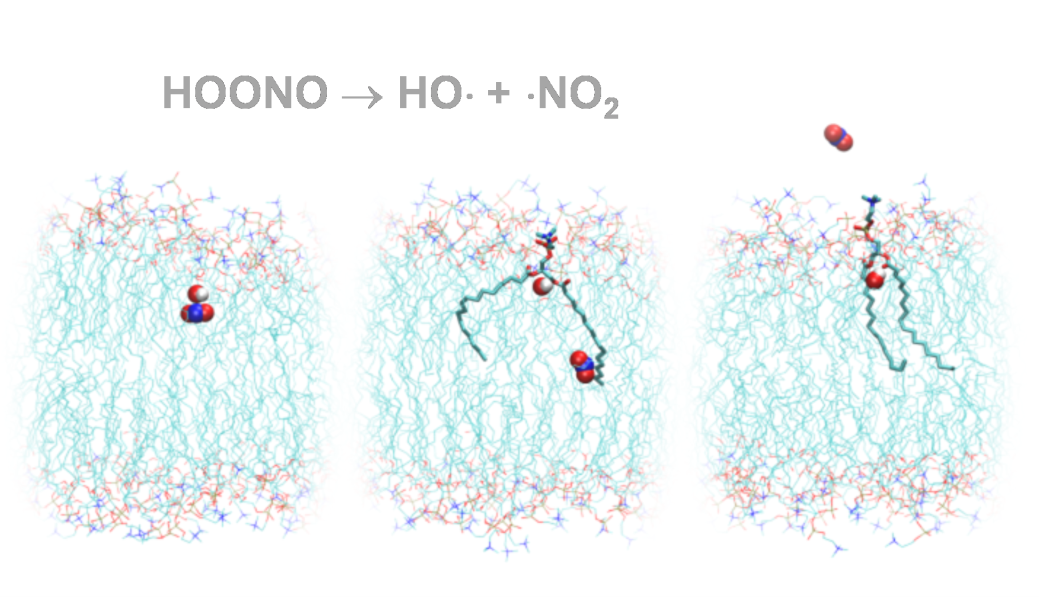
Reactive oxygen and nitrogen species (RONS) govern critical processes in biology and atmospheric chemistry, yet their fleeting dynamics often elude experimental tracking. Quantum chemistry is the go-to method for studying RONS, but fully classical molecular dynamics (MD) simulations, though unconventional for such transient species, offer unique insights into their interactions at complex interfaces. This self-reflective review chronicles a decade of our group’s work developing the GROMOS-RONS force field, harnessing MD’s computational efficiency to explore RONS in lipid bilayers, aquaporin channels, and water-air interfaces. These studies challenge the view of RONS as mere diffusible threats, revealing their selective enrichment and prolonged residence at critical interfacial regions. Simulations uncover nitro-oxidative pathways and transport mechanisms that shed light on unresolved experimental questions. Applications in signaling, therapy, and aerosol chemistry are highlighted, alongside challenges and future directions. By showcasing the GROMOS-RONS model’s strengths for condensed-phase MD, we aim to inspire its broader application as a complementary tool to study RONS dynamics across diverse fields.