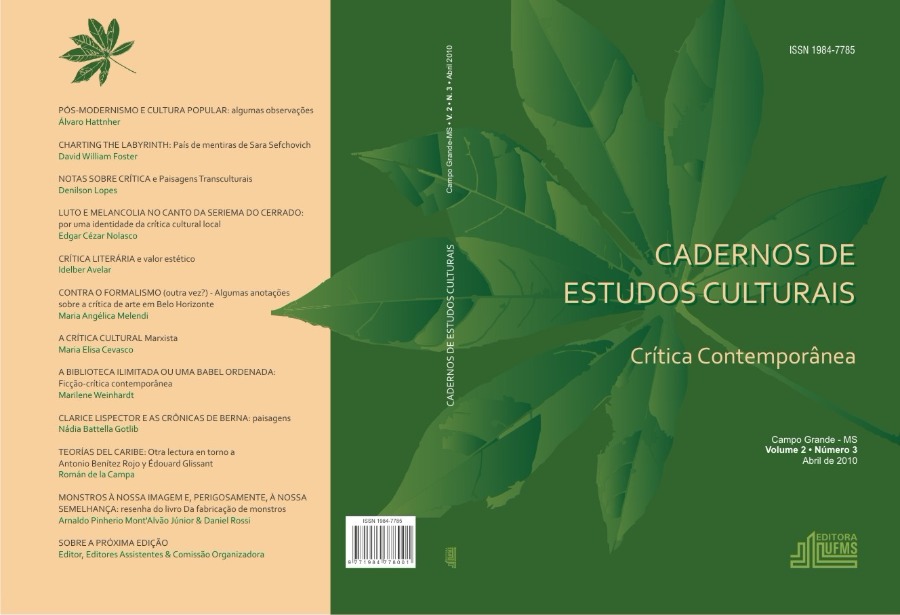
TEORÍAS DEL CARIBE: Otra lectura en torno a Antonio Benítez Rojo y Édouard Glissant
Resumo
Es consabido que el Caribe engloba una heterogeneidad desafiante cuyo valor epistémico se vuelve ineludible a partir de la primera mitad del siglo veinte. La obra de Fanon, Cesáire, Guillén, C.L.R. James, y Fernando Ortiz, entre otros, suelen ser los hitos mas reconocibles de esta periodización. Sincretismo, transculturación, negritud y otras categorías análogas posibilitaron el pensamiento crítico sobre la sociedad y las artes antillanas, componiendo todo un legado conceptual que eventualmente condujo a una auscultación mas profunda de la propia filosofía continental y sus proclamaciones universales. Desde finales del veinte se observan otros deslindes—hibridismo, subalternidad y mimicry, por ejemplo—inscritos ya sea en lo posmoderno o lo poscolonial, u otras propuestas de época que motivan gran parte de los estudios mas recientes sobre el Caribe, al igual que sobre la cultura mundial. No hay duda que estas periodizaciones y sus modos de análisis siguen nutriendo debates y exigiendo precisiones. Uno de ellos gira en torno a la implosión cada vez más observable en cuanto al sentido del Otro, la cual sin duda exige también reexaminar la constitución del sujeto humano a partir de un orden simultáneamente poscapitalista y post- socialista, una cartografía inédita de multitudes, migraciones y diásporas gene- ralizadas, toda una gama de temas desafiantes que hoy se abordan desde códi- gos epistémicos que se saben inestables. Tal podría ser la característica funda- mental del legado saussureano que corre por el pensamiento del último siglo hasta llegar al corte deconstructivo, el cual conduce al desafío de una profunda y fascinante indeterminación en cuanto al saber.
Referências
ANDERSON, Debra L. 1995. Decolonizing tthe Textt: Glissanttian Readings in Caribbean and African- American Litterattures. New York: Peter Lang.
BENÍTEZ-ROJO, Antonio. 1989. La isla que se repitte: El Caribe y la perspecttiva posmoderna. Hanover, NH: Ediciones del Norte.
——. 1992. The Repeatting Island. Durham: Duke University Press. Translated by James Maraniss.
BEVERLEY, John and Marc Zimmerman, eds. 1990. Litteratture and Polittics in tthe Centtral American Revoluttions. Austin: University of Texas Press.
BHABHA, Homi. [1986]. 1994. “Remembering Fanon: Self, Psyche and the Colonial Condition.”
Colonial Discourse and Postt-Colonial Theory. Ed. by Patrick Williams and Laura Chrisman, 112–
New York: Columbia University Press.
——. 1984. “Of Mimicry and Man: The Ambivalence of Colonial Discourse.October.” 28: 125– 33.
BUTLER, Judith. 1990. “Contingent Foundations: Feminism and the Question of Postmodernism.”
Feministts Theorize tthe Polittical. Ed. by Judith Butler and Joan Scott, 3– 28. N. Y.: Routledge.
CAILLER, Bernadette. 1989. “Édouard Glissant: A Creative Critic.” World Literature Today. 63.4: 589– 92.
CHANADY, Amaryll, ed. 1994. Lattin American Identtitty and Consttructtions of Difference. Minneapolis: University of Minnesota Press.
CORONIL, Fernando. 1993. “Challenging Colonial Histories: CubanCounterpoint/Ortiz’s Counterfetishism.” Crittical Theory, Culttural Polittics, and tthe Lattin American Narrattive. Ed. by Steven M. Bell, Albert H. LeMay, and Leonard Orr, 61– 80. South Bend, Indiana: Notre Dame University Press.
DASH, J. Michael. 1989. Inttroducttion [tto] Caribbean Discourse by Édouard Glissantt, xi– xlvii. caraf books. Charlottesville: University Press of Virginia.
——. 1995. Édouard Glissantt. New York: Cambridge University Press.
de la Campa, Román. 1980. Relectura y redescubrimiento del Contrapunteo cubano. Areito. 7.27: 46– 48.
——. 1995. “Postmodernism and Revolution: A Central American Case Study.” Latte Imperial Cultture. Ed. by Román de la Campa, E. Ann Kaplan, and Michael Sprinker, 122– 48. New York; London: Verso.
. 1999. “Caribbean Discourse”, Lattin Americanism, University of Minnesota Press. de Man, Paul. 1971. Blindness and Insightt. New York: Oxford University Press.
——. 1979. Allegories of Reading. New Haven, Connecticut: Yale University Press.
——. 1986. The Resisttance tto Theory. Minneapolis: University of Minnesota Press. DERRIDA, Jacques. 1994. Spectters of Marx. New York: Routledge.
DIAZ, Junot. 2007. The Wondrous Life of Oscar Wao.
DIRLIK, Arif. 1994. Aftter tthe Revoluttion: Waking tto Global Capittalism. Hanover, NH: University Press of New England.
FOUCAULT, Michel. 1988. “Technologies of the Self.” Technologies of tthe Self. Ed. by Luther H. Martin, Huck Gutman, Patrick H. Hutton, 16– 50. Amherst: University of Massachussets Press.
GATES, Henry Louis, Jr. 1991. “Critical Fanonism. Critical Inquiry.” 17: 457– 70. GIROUX, Henry. 1992. Border Crossings. New York: Routledge.
GLISSANT, Édouard. 1981. Le discours anttillais. Paris: Seuil.
——. 1989. Caribbean Discourse. caraf books. Charlottesville: University Press of Virginia. Translated by J. Michael Dash.
GONZÁLEZ Echevarría, Roberto. 1977. Alejo Carpenttier, tthe Pilgrim att Home. Ithaca, NY: Cornell University Press.
GONZÁLEZ Echevarría, Roberto. 1987. La rutta de Severo Sarduy. Hanover, NH: Ediciones del Norte.
HALL, Stuart. [1990]. 1994. Cultural Identity and Diaspora. Colonial Discourse and Postt-Colonial Theory. Ed. by Patrick Williams and Laura Chrisman, 392– 403. New York: Columbia University Press.
HENRY, Paget and Paul Buhle, eds. 1992. C. L. R. James’s Caribbean. Durham, NC: Duke University Press.
HOPENHAYN, Martin. 1993. “Postmodernism and Neoliberalism in Latin America.” boundary 2. 20.3: 93– 109.
HUTCHEON, Linda. 1995. Introduction: Complexities Abounding. PMLA. 10.1: 7– 16.
JAMESON, Fredric. 1984. Postmodernism; or, The Cultural Logic of Late Capitalism. New Left Review. 146: 53– 92.
——. 1986. Third-World Literature in the Era of Multinational Capitalism. Social Text. 15: 65– 88. LACLAU, Ernesto. 1990. New Reflecttions on tthe Revoluttion of Our Time. London; New York: Verso.
——, ed. 1994. The Making of Polittical Identtitties. London; New York: Verso.
LAZARUS, Neil. 1994. “National Consciousness and the Specicity of (Post)Colonial Intellectualism.” Colonial Discourse, Posttcolonial Theory. Ed. by Francis Barker, Peter Hulme, and Margaret Iversen, 196– 220. New York: Manchester University Press.
LEZAMA Lima, Jose. La expresion americana. Zizek, Slavoj. 2006. The Parallax View. Cambridge, Massachusetts Institute of Technology.
Downloads
Publicado
Edição
Seção
Licença

Este obra está licenciado com uma Licença Creative Commons Atribuição-NãoComercial 4.0 Internacional.