
Orbital - Vol. 17 No. 3 - Special Issue 2025
FULL PAPERS

Strontium Titanate (SrTiO3) for Adsorption of Cd(II) Ions and Photodegradation of Methylene Blue Dye in Aqueous Solutions
Amanda das Graças Barbosa
Institute of Chemistry, Federal University of Catalãol (UFCAT)
Vanessa Nunes Alves
Institute of Chemistry, Federal University of Catalãol (UFCAT)
Cristiano Morrita Barrado
Institute of Chemistry, Federal University of Catalãol (UFCAT)
Tânia Regina Giraldi
Institute of Science and Technology, Federal University of Alfenas (Unifal)
Fabiana Villela Motta
LSQM – Laboratory of Chemical Synthesis of Materials – Department of Materials Engineering, Federal University of Rio Grande do Norte – UFRN
Benjamin Monteiro da Silva
LSQM – Laboratory of Chemical Synthesis of Materials – Department of Materials Engineering, Federal University of Rio Grande do Norte – UFRN
Alberthmeiry Teixeira de Figueiredo
Institute of Chemistry, Federal University of Catalãol (UFCAT)
Published May 30, 2025
Keywords
  • Adsorption,
  • Hydrothermal-microwave,
  • Photocatalysis,
  • Polymeric precursors,
  • SrTiO3
How to Cite
(1)
das Graças Barbosa, A.; Nunes Alves, V.; Morrita Barrado, C.; Regina Giraldi, T.; Villela Motta, F.; Monteiro da Silva, B.; Teixeira de Figueiredo, A. Strontium Titanate (SrTiO3) for Adsorption of Cd(II) Ions and Photodegradation of Methylene Blue Dye in Aqueous Solutions. Orbital: Electron. J. Chem. 2025, 17, 276-281.

Abstract

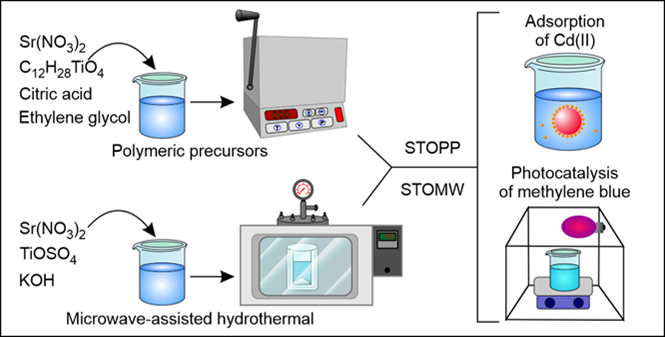
Strontium titanate (SrTiO3 – STO) is a metal oxide with a perovskite structure that has attracted scientific interest due to its various applications. The present study aims to synthesize STO and evaluate its potential for adsorption of Cd(II) ions and photodegradation of methylene blue. The STO samples were synthesized using the polymer precursor method and microwave-assisted hydrothermal method. X-ray diffraction analysis confirmed the formation of STO crystalline phase, and scanning electron microscopy revealed differences morphology to distinct synthesis method used. STOMW sample was able to remove 94.7% of Cd(II) ions in solution, while STOPP sample demonstrated good photocatalytic activity, with 80% dye degradation. The results indicate that STO is a promising material for the removal of both inorganic and organic contaminants from aqueous waste.