Published 2025-08-30
Keywords
- Synthetic effluents,
- Dyes,
- Coagulation,
- Filtration,
- Ion exchange
How to Cite



Abstract
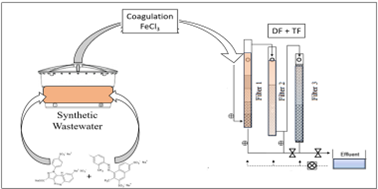
The present study evaluated the treatment of synthetic effluent containing azo dyes using a coagulation system followed by double filtration (DF) and triple filtration (TF). Treatment efficiency was assessed based on the removal of Chemical Oxygen Demand (COD), Biochemical Oxygen Demand (BOD), Linear Alkyl Sulfate (LAS), Total Nitrogen (TN), nitrate, nitrite, turbidity, color, and the dyes Ponceau and Tartrazine. After coagulation and DF, removals reached 76.73% COD, 81.31% BOD, 42.31% LAS, 80.00% TN, 40.96% nitrate, 100.00% nitrite, 99.58% turbidity, and 92.86–100.00% color. Following TF, removals were greater than 77.00% for nitrate, above 98.00% for COD and BOD, and approximately 100.00% for LAS, TN, nitrite, turbidity, and color. Although chloride and conductivity removals were low, the values remained within the effluent disposal limits established by Brazilian legislation. For the dyes, the DF step achieved over 40.00% removal, while TF reduced dye concentrations below the quantification limits for both Ponceau and Tartrazine. The main removal mechanisms were adsorption via the porosity of activated carbon and ion exchange by zeolite. Overall, the combined coagulation, DF, and TF processes demonstrated high removal efficiencies for most evaluated parameters, indicating their suitability for treating effluents containing azo dyes.