
Detection of Gunshot Residues in Puparia of Blowfly (Chrysomya albiceps) and the Influence of Time and Firing Modality
Published 2026-01-13
Keywords
- Inductively Coupled Plasma Mass Spectrometry,
- Contact shot,
- Close-range shooting,
- Entomological evidence
Copyright (c) 2026 Orbital: The Electronic Journal of Chemistry

This work is licensed under a Creative Commons Attribution-NonCommercial-NoDerivatives 4.0 International License.
How to Cite



Abstract
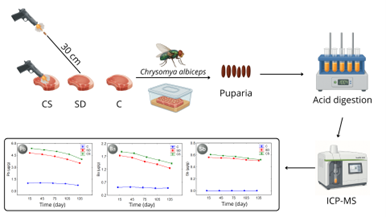
Firearm-related homicides are a global concern, and determining the cause of death in highly decomposed remains a challenge in forensic investigations. This study explores the potential of gunshot residue (GSR) analysis in blowfly (Chrysomya albiceps) puparia as a forensic tool, correlating residue levels with firing distance and time since death. Three pork samples were subjected to different shooting conditions: close-range shots, contact shots, and a control (no shots). C. albiceps larvae were reared on these samples, and puparia were collected at intervals from 15 to 135 days post-shooting. Inductively coupled plasma mass spectrometry (ICP-MS) analysis revealed significantly higher levels (p < 0.05) of lead (Pb), barium (Ba), and antimony (Sb) in puparia from shot samples compared to the control, with contact shots showing the highest concentrations. Additionally, a time-dependent decrease in GSR levels was observed. These findings support the use of forensic entomotoxicology in shooting cases, demonstrating that puparial GSR analysis can help estimate shooting conditions and postmortem interval.