
Published 2025-05-17
Keywords
- antibacterial, bioglass scaffolds, hydroxyapatite, silver nanoparticle
How to Cite



Abstract
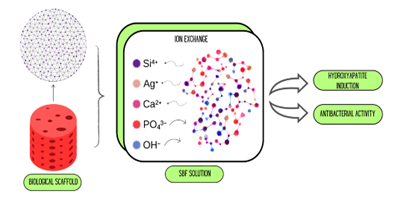
Infections caused by bacteria are among the main factors for the rejection of materials used in implants. Ceramic scaffolds containing silver have been shown to be bioactive and bactericidal for different strains of bacteria. In this work, glasses containing silver were synthesized by the sol-gel method to obtain scaffolds. Bands were observed in the 1200–930 cm-1 region that can be attributed to Si–O–Si bonds, but also bands of overlapping phosphate groups, bands at 490 cm-1 of Si–O–NBO, Si–O-Zn, and diffraction peaks corresponding to the hydroxyapatite phase. Bioactivity tests in the presence of the body fluid simulating solution (SBF) and antibacterial activity tests indicate that the glass and scaffolds are bioactive and bactericidal.