
Eco-friendly Synthesis and Characterization of Bioactive Iron Oxide Nanoparticles Using Tagetes erecta Leaf Extract for Antioxidant and Anti-Corrosion Application
Published 2025-12-16
Keywords
- Antioxidant activities,
- Anti-Corrosion activities,
- Green Synthesis,
- Iron Nanoparticles,
- Metal oxides
How to Cite



Abstract
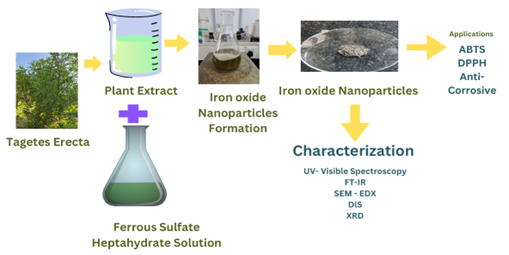
In this study, we present a sustainable and efficient approach for synthesizing bioactive iron oxide nanoparticles (FeO NPs) using Tagetes erecta leaf extract, an eco-friendly and readily available biological resource. The green synthesis method not only eliminates the need for hazardous chemicals but also leverages the plant’s bioactive compounds, which act as natural reducing and stabilizing agents. The synthesized FeO NPs were meticulously characterized through various advanced techniques, including UV-visible spectroscopy, FTIR, SEM-EDX, XRD, and DLS, confirming their formation, structural attributes, and spherical morphology. The antioxidant potential of FeO NPs was evaluated using DPPH and ABTS assays, revealing significant free radical scavenging activities, particularly in the DPPH assay with a scavenging percentage of 92.91%, comparable to standard antioxidants like ascorbic and gallic acids. Furthermore, the FeO NPs demonstrated exceptional anti-corrosion capabilities, achieving a maximum inhibition efficiency of 79.5% at a concentration of 40 mg, as verified through electrochemical impedance spectroscopy and potentiodynamic polarization methods. This was supported by weight-loss studies, which highlighted superior performance at higher concentrations. By utilizing Tagetes erecta leaves, known for their rich bioactive profile and medicinal properties, this research advances the field of green nanotechnology. It underscores the feasibility of developing multifunctional nanoparticles for applications in environmental protection, biomedicine, and industrial corrosion prevention. This work provides a promising framework for integrating sustainability into nanomaterial synthesis while enhancing their functional properties.