
Evaluating the Toxicity and Genotoxicity of Naproxen and Ketoprofen Using Factorial Design: A Study with Artemia salina and Allium cepa
Published 2026-01-12
Keywords
- Naproxen and ketoprone,
- Artemia salina,
- Allium cepa,
- Genotoxicity,
- Experimental design
Copyright (c) 2026 Orbital: The Electronic Journal of Chemistry

This work is licensed under a Creative Commons Attribution-NonCommercial-NoDerivatives 4.0 International License.
How to Cite



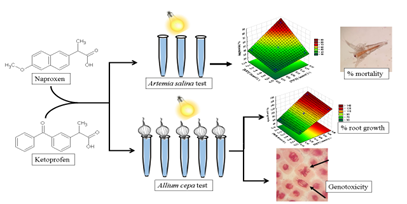
Abstract
The nonsteroidal anti-inflammatory drugs (NSAID) are excreted unchanged in the environment that can have toxic effects on living organisms. Among these drugs, naproxen and ketoprone are widely used. Thus, a study was proposed to evaluate the interaction between different concentrations (mmol L-1) of the variables naproxen [NPX] and ketoprone [KET] against the acute toxicity of the Artemia salina (A. salina) and Allium cepa (A. cepa) applying the 22 factorial design. Responses were used: percent A. salina mortality (% mortality) and A. cepa root growth (% root growth). For A. salina, after 72 h of exposure with ([NPX] and [KET] = 0.15 mmol L−1) caused an 80% mortality. While A. cepa root growth was higher with ([NPX] and [KET] = 0.03 mmol L−1) exhibiting 133.58% root growth. However, genotoxicity was shown by the highest frequency of the values of chromosomal alterations (CA) with 46.8% CA±9.16, when compared with the negative control equal 12.6% CA±6.39. Thus, from the test (p<0.05) with the p-values of 0.0302. The lower concentrations showed necrosis and micronuclei with 1.82%±1.66 apoptotic index and 5.4%±1.40 micronuclei for 5025 cells counted. Therefore, drugs demonstrated high A. salina acute toxicity and potential genotoxic and mutagenic effect for A. cepa based.