
Synthesis of 2-((5-(phenylamino)-1,3,4-thiadiazol-2-yl)thio)acetic Acid and Theoretical Evaluation of Its Biological Activity
Published 2026-02-19
Keywords
- Histamine H3 receptor,
- thiadiazoles,
- synthesis,
- X-ray crystallography,
- 2-((5-(phenylamino)-1,3,4-thiadiazol-2-yl)thio)acetic acid
Copyright (c) 2026 Orbital: The Electronic Journal of Chemistry

This work is licensed under a Creative Commons Attribution-NonCommercial-NoDerivatives 4.0 International License.
How to Cite



Abstract
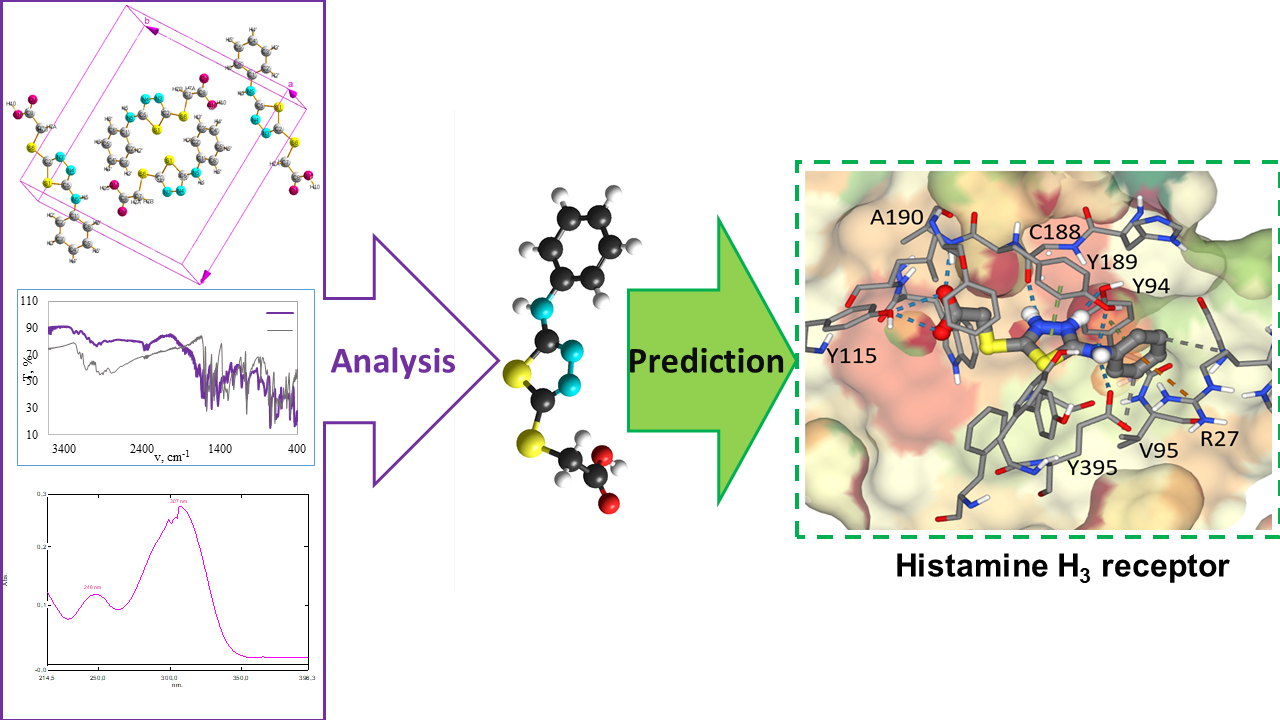
2-((5-(phenylamino)-1,3,4-thiadiazol-2-yl)thio)acetic acid exhibits a variety of biological activities. Consequently, the synthesis, structure, and biological activity of this compound were investigated. The synthetic procedure is described in detail on a step-by-step basis, with the compound's composition and structure confirmed by FTIR, UV–Vis spectroscopy, and X-ray crystallography. Additionally, pharmacokinetic and toxicological properties were predicted using the ADMETPred program. The biological potential was further evaluated through the 3DStarPred program and molecular docking studies, which revealed high affinity for the human histamine H3 receptor, suggesting a potential role as an antagonist/inverse agonist in the central nervous system. Overall, these findings indicate that the synthesised compound represents a promising candidate for further medicinal development.