
Published 2017-07-02
Keywords
- glyphosate@B12N12 complex,
- adsorption process,
- thermodynamic properties,
- DFT
How to Cite
Abstract
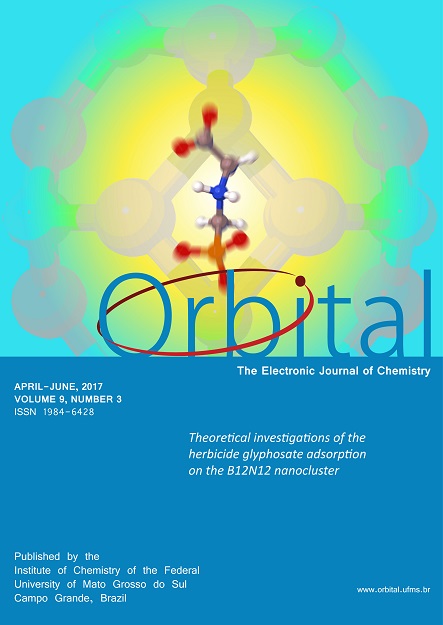
Nowadays is emergent the development of new materials which can be used in the adsorption process to remove herbicide glyphosate from the aquatic environment. Therefore, density functional theory (DFT) calculations were performed to study the adsorption process of the glyphosate on the B12N12 nanocage in aqueous media. The optimized structures of adsorbed glyphosate do not affect the nanocage structure indicating its structural stability. The chemisorption of this herbicide is an exothermic process with −43.89 kcal.mol-1. The most stable complex displayed an adsorption energy and ∆G values of −53.97 and −40.79 kcal.mol-1, respectively. The HOMO (highest occupied molecular orbital) and LUMO (lowest unoccupied molecular orbital) energies are located in the glyphosate implying that this herbicide can be removed by chemical reaction. Our results show that the B12N12 nanocluster can be a suitable new nanomaterial to remove the glyphosate from wastewater.