
Formulation of a Unique Mobile Phase for TLC-based Isolation of Polar and Nonpolar Pigments in Acalypha wilkesiana Müll.Arg. Leaves
Published 2026-07-05
Keywords
- Plant pigments,
- Planar chromatography,
- paper chromatography,
- Thin-layer chromatography,
- Anthocyanin
Copyright (c) 2026 Orbital: The Electronic Journal of Chemistry

This work is licensed under a Creative Commons Attribution-NonCommercial-NoDerivatives 4.0 International License.
How to Cite



Abstract
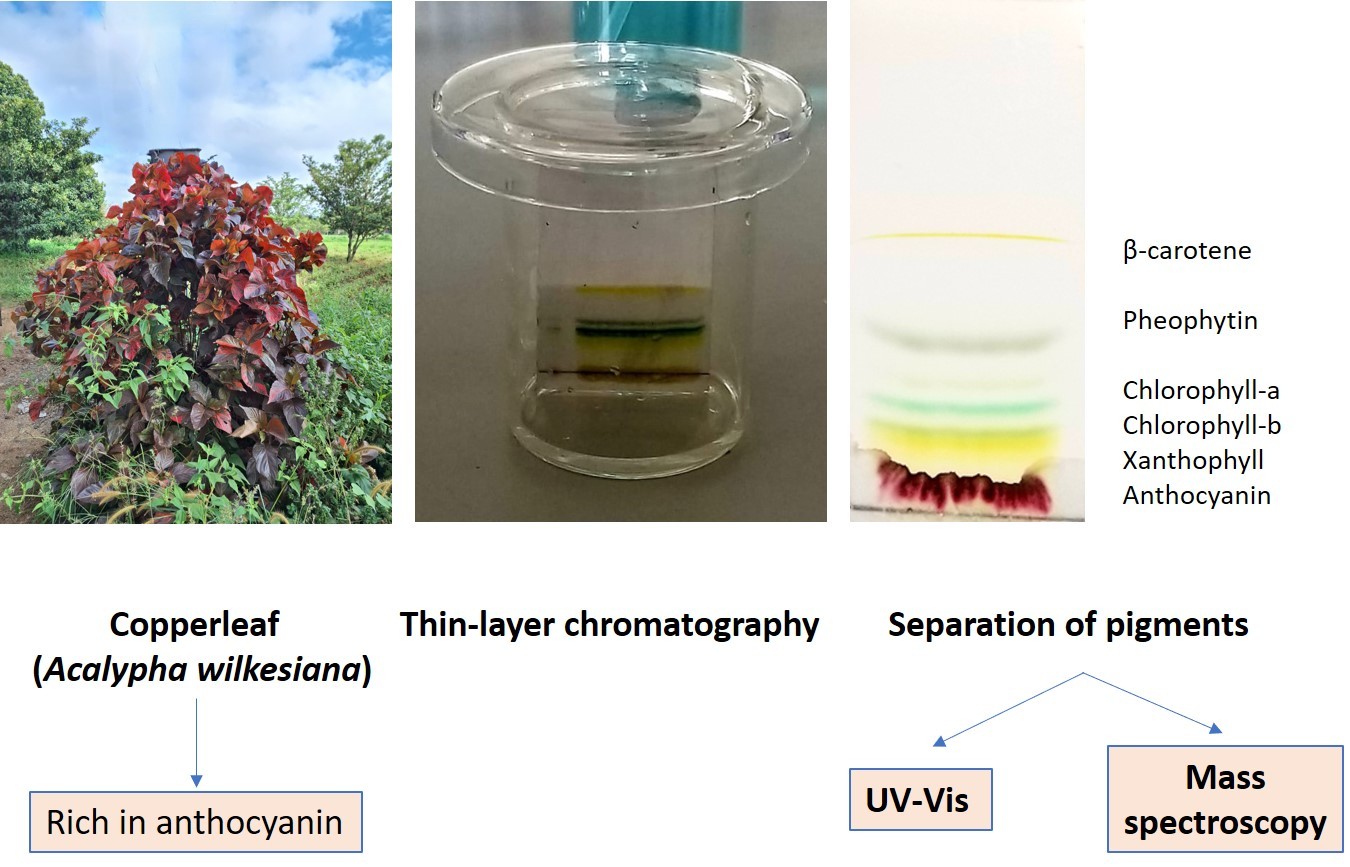
Plant species contain several pigments that are responsible for different functions. Depending on the structures of these pigments, some of these pigments are nonpolar (chlorophyll-a, chlorophyll-b, β-carotene, xanthophyll, etc.), whereas some are polar (anthocyanins), thus making them hydrophobic or hydrophilic, respectively. To understand more about the structure and properties of these pigments, it is essential to isolate them in pure forms. So far, planar chromatographic techniques have been mostly employed to separate nonpolar pigments from one another, but not from the polar ones. Here we are reporting a novel solvent composition (60% n-hexane, 10% ethyl acetate, 10% acetone, 10% isopropyl alcohol, 10% water), that can be used to separate the nonpolar pigments from the polar ones using thin-layer chromatography (TLC). This solvent composition enabled us to develop a chromatogram, where spots were distinctly separated, concentrated, and could easily be isolated. The pigments were identified from their colors and Rf (retardation factor) values, followed by characterization using ultraviolet-visible (UV-Vis) spectra and mass spectrometric analysis.