
Determination of Sodium in Dietary Supplements: An Interdisciplinary Proposal for Teaching Analytical Chemistry in the Technical Chemistry Course – Part I
Published 2026-07-01
Keywords
- Analytical Chemistry Teaching,
- Accuracy,
- Method Validation,
- Precision,
- Protein Food Supplements
Copyright (c) 2026 Orbital: The Electronic Journal of Chemistry

This work is licensed under a Creative Commons Attribution-NonCommercial-NoDerivatives 4.0 International License.
How to Cite



Abstract
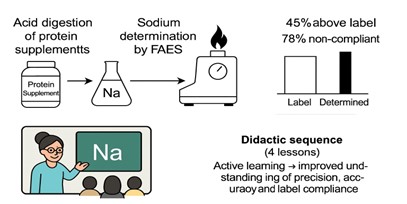
The discipline of analytical chemistry involves developing and improving methods to identify, separate, and quantify substances in a sample. This study proposes an experimental methodology for determining the sodium content of nine (9) protein food supplements using flame atomic emission spectrometry after acid decomposition. Analytical validation focused on precision and accuracy through repeatability, intermediate precision, and analyte addition/recovery tests. The procedure showed adequate precision (RSD < 16.6%) and accuracy (recoveries between 78–110%). Comparison with nutritional labels at a 95% confidence level revealed that 78% of the supplements analyzed had sodium levels statistically different from the declared values, with 45% above the stated values, highlighting the risk of excessive intake. In addition, a didactic sequence was developed, structured in four lessons, integrating analytical chemistry with food and nutrition education. Moreover, the proposed didactic sequence establishes a clear learning flow, guiding students from conceptual discussion to experimental practice and data interpretation. This structure enables them to connect precision and accuracy with real-world analytical problems, enhancing critical thinking and promoting meaningful learning. This active methodology enabled students to connect validation concepts (precision and accuracy) to real-world issues, promoting critical thinking and meaningful learning.