
Foremost Study During the Investigation of Separation of Organic Dyes from Wastewater Using Low Cost Biomaterials: A Review
Published 2026-02-19
Keywords
- Dyes,
- adsorption,
- pH,
- heavy metals,
- Agriculture waste
- bioadsorbents ...More
Copyright (c) 2026 Orbital: The Electronic Journal of Chemistry

This work is licensed under a Creative Commons Attribution-NonCommercial-NoDerivatives 4.0 International License.
How to Cite



Abstract
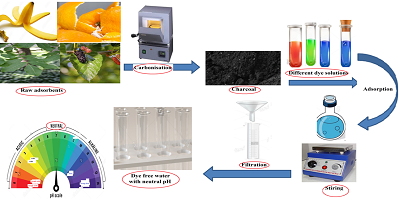
Wastewater producing from different sources like textile industry, rubber industry, paper industry, leather industry, cosmetic industry etc. contains a large amount of organic and inorganic chemicals such as dyes, dye intermediates, heavy metal ions etc. This review article is about the removal of dyes from wastewater using plant materials. Among different methods used so far, adsorption by plant materials is inexpensive and easy alternative method for the removal of dyes from wastewater. Dyes have very harmful impact on the environment especially on aquatic life which in turn has adverse effect on human beings. Therefore, it is essential to classify these dyes and find some suitable, easy and inexpensive method for their removal. Utilization of adsorption has gained great importance for the protection of environment by removing dyes from wastewater. Some adsorbents are effective but expensive, harmful and nonbiodegradable while as some are ineffective. That is why, new effective adsorbents are needed which should be least expensive, energy efficient, biodegradable and easily available. Plant material is mainly composed of lignin and cellulose and has good adsorbent property, easily available, cheap, biodegradable and nontoxic. From the survey of research papers, it was found that agricultural wastes have outstanding capabilities for adsorption. In this article we have mentioned the key study during adsorption process and reviewed the suitability and efficiency of both raw and chemically modified agricultural products in the removal of dyes from wastewater.