
Chemotaxonomic Studies on Some Stereocaulon (Stereocaulaceae, Lichenized Ascomycota) from Southern South America and Antarctica
Published 2025-12-18
Keywords
- chemotaxonomy,
- HPLC-MS,
- Mass spectrometry,
- Lichens,
- Thin-layer chromatography
How to Cite



Abstract
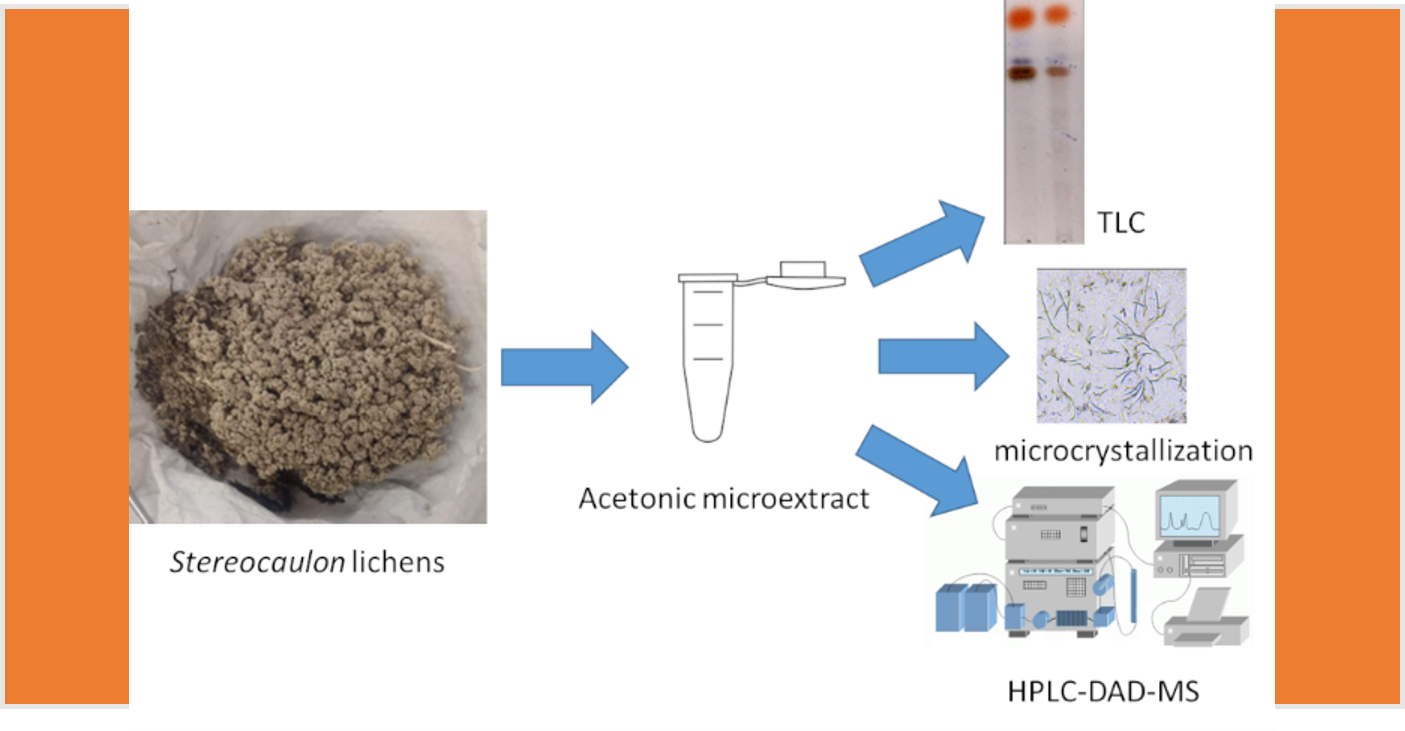
Lichenized fungi (lichens) produce many compounds especially those derived from the polyketide pathway. These are predominantly phenolic compounds, most of which are unique to lichens, and long-chain fatty acids. These compounds play an important role in the chemotaxonomy of lichens, as they serve as chemical markers for identification at different taxonomic levels. In this work, 100 exsiccates of lichens of the genus Stereocaulon collected in Antarctica, Chile and Argentina were analyzed using thin layer-chromatography, microcrystallization and high-performance liquid chromatography coupled with mass spectrometry. A total of 21 compounds were annotated: rangiformic, norrangiformic, pseudonorrangiformic, vinapraesorediosic B and bourgeanic acids (fatty acids); lobaric, norstictic, menegazziaic, hypoconstictic, colensoic, stictic acids (depsidones); atranorin, gyrophoric acid, -ene''-ene''' glomelliferic acid (depsides); strepsilin (dibenzofuran); lobarin (diphenylether), oxysiphulin (chromone) and four new depsidones: 2''-ene lobaric, 3''-ene lobaric and 4''-ene lobaric and – ene''' lobaric acids. The results of the chemical analysis corroborated the identification obtained through morphological analysis and, in some cases, also allowed the species to be separated into chemical groups. The following species were identified: Stereocaulon corticatulum, S. alpinum (2 chemical groups), S. melanopotamicum, S. implexum, S. tomentosum (4 chemical groups), S. tomentosum var. capitatum (2 chemical groups), and Stereocaulon argus (3 chemical groups).