
Influence of the Collection Site on the Chemical Composition and Potential Antioxidant and Photoprotector of Teas from the Leaves of Campomanesia adamantium (Cambess.) O. Berg
Published 2026-01-12
Keywords
- Chemical variability,
- Guavira,
- Medicinal teas
How to Cite



Abstract
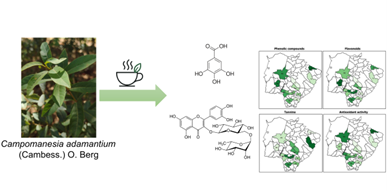
The need for alternative products that aid in the treatment of diseases is becoming increasingly common. As a result, medicinal plants present themselves as an alternative for the treatment and prevention of comorbidities. Within this context, Campomanesia adamantium emerges as a species of great interest in the Cerrado, with significant economic, cultural, and historical value in Mato Grosso do Sul. However, there is still a lack of studies evaluating its therapeutic potential. The secondary metabolites vary due to biotic and abiotic factors, which interfere with the therapeutic action of the plant. Therefore, the present study aimed to evaluate the variation in chemical composition and the antioxidant and photoprotective potential of teas made from the leaves of C. adamantium collected in eleven municipalities of Mato Grosso do Sul. The teas were prepared by infusion, at a ratio of 0.5% (w/v). Spectrophotometric methods were used to determine the levels of phenolic compounds, flavonoids, tannins, and antioxidant and photoprotective potential, as well as the determination of compounds by high-performance liquid chromatography. The results indicated variation in the chemical composition of the leaves concerning the municipalities of collection, which resulted in a variation in antioxidant potential between 11.5% and 87.2%. Intense or excessive exposure to UV-A and UV-B rays can cause health damage and premature aging; therefore, the samples presented an SPF higher than 13, classifying them in the categories of low and medium protection. Among the municipalities analyzed, the samples collected in the municipality of Cassilândia stood out, presenting higher levels of secondary metabolites and, consequently, the best potential, highlighting the region compared to the others.