Development of Website Based Learning Media with Problem Based Learning Model to Improve Student Learning Outcomes on Chemical Equilibrium Material at High School Level
Published 2026-07-01
Keywords
- Learning media,
- PBL,
- Learning outcomes,
- Chemical equilibrium
Copyright (c) 2026 Orbital: The Electronic Journal of Chemistry

This work is licensed under a Creative Commons Attribution-NonCommercial-NoDerivatives 4.0 International License.
How to Cite



Abstract
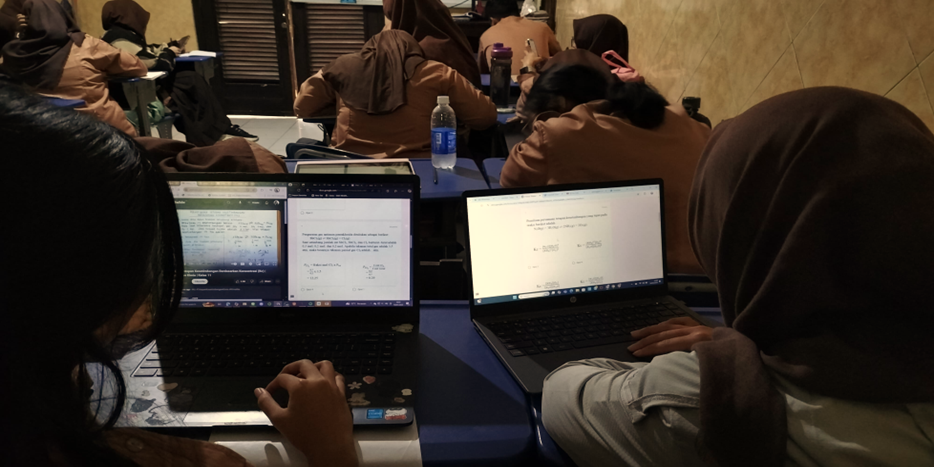
This study aimed to develop and produce a website-based learning media integrated with the Problem-Based Learning (PBL) model on chemical equilibrium topics, to examine the product’s validity, feasibility, and practicality, as well as to evaluate its effectiveness on students learning outcomes. The research employed a Research and Development (R&D) approach using the ADDIE development model integrated with the PBL model and supported by Google Sites. The study involved 34 eleventh-grade students and applied a pre-experimental research method with a one-group pretest–posttest design. The results indicated that the website-based learning media demonstrated a very high level of validity. The feasibility test showed that the product met the feasible criteria, while the practicality test indicated that the media was categorized as very practical. The implementation of the learning media had a positive impact on students’ learning outcomes, as evidenced by an N-gain score of 0.564, classified as a moderate improvement, and an effect size of 1.05, classified as a very large improvement. These findings demonstrate that website-based learning media integrated with the Problem-Based Learning model is effective as an instructional innovation in chemistry education to enhance the quality of both the learning process and students’ learning outcomes, and it has the potential to serve as a reference for the development of digital learning media in other chemistry topics.