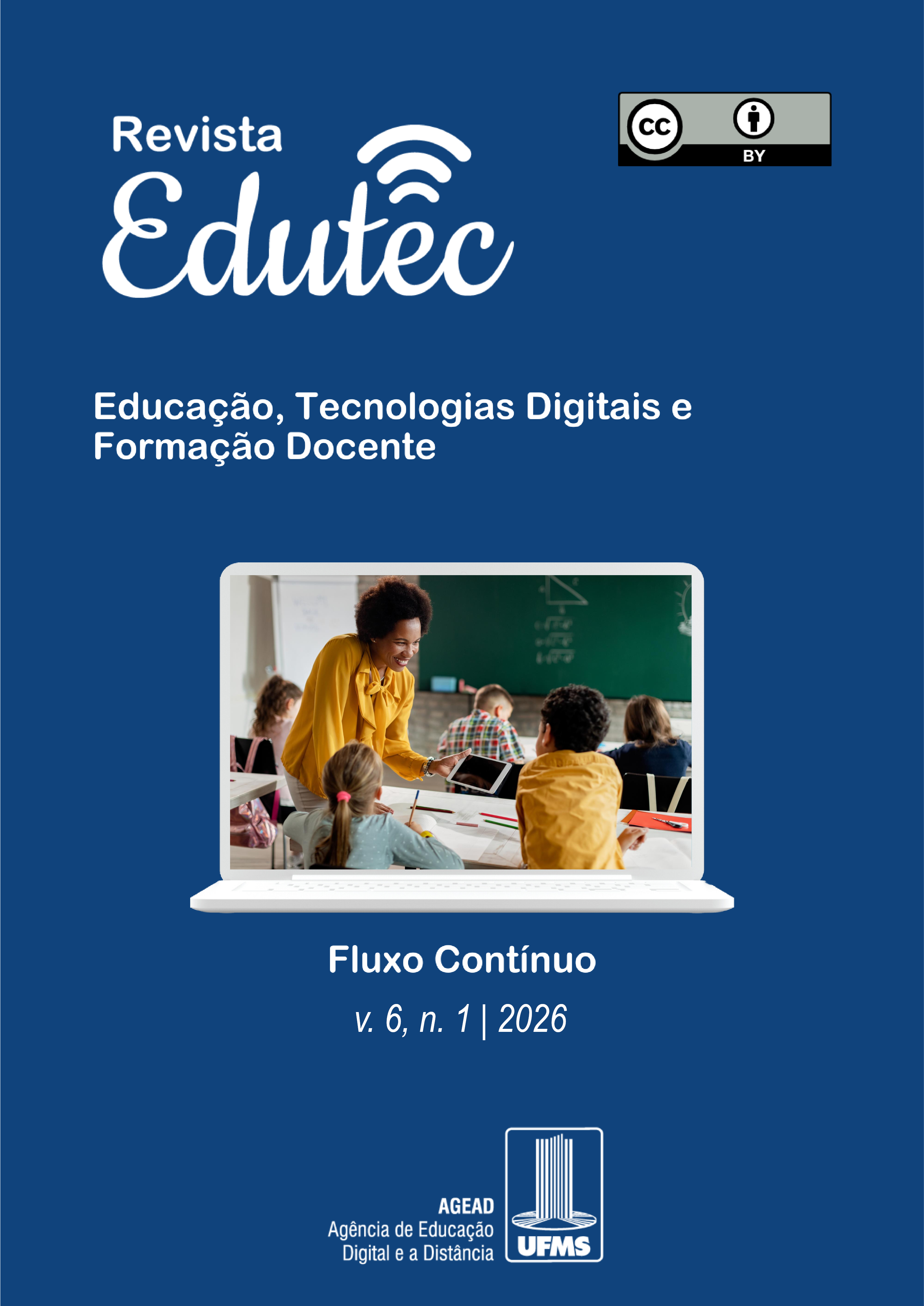
Between algorithms and scientific methodology
Essay on scientific research mediated by artificial intelligence in Higher Education
DOI:
https://doi.org/10.55028/edutec.v6i1.24574Keywords:
Teaching practices, Scientific methodology, Scientific illustrationAbstract
This essay discusses the challenges and potentialities of using Artificial Intelligence (AI) tools in scientific research in Higher Education, with a focus on teaching practice. To this end, four tools were analyzed: Bing Image Creator, Happy Scribe, Perplexity.ai, and Consensus, organized into three categories of application: a) scientific illustration generators; b) transcribers for netnographic research; and c) search mechanisms for scientific articles in databases. It was observed that Bing Image Creator offers resources for creating inclusive images, facilitating the illustration of concepts and procedures in an attractive and innovative way. Happy Scribe proved useful for transcribing and organizing data from secondary sources, especially in netnographic research, speeding up previously time-consuming stages of the investigative process. Perplexity.ai and Consensus demonstrated potential to support the search and initial analysis of scientific literature, optimizing access to sources and evidence. However, the experience also revealed important challenges, such as the need for critical AI literacy, information validation, attention to research ethics, plagiarism prevention, data privacy, and recognition of algorithmic biases. Thus, these technologies should be understood as support tools, and not as substitutes for the researcher’s intellectual activity. This study contributes to the discussion on the ethical, critical, and responsible integration of AI in academic training, highlighting the importance of teacher and student training for transforming investigative processes.
References
ABATE, A. A. A Netnografia como metodologia de investigação em Geografia: Um estudo para a compreensão da mobilidade urbana excludente e precária em Ribeirão Preto - SP. Revista Formação (Online), v. 30, n. 57, p. 429-464, 2023. Disponível em: https://doi.org/10.33081/formacao.v30i57.9320. Acesso em: 13 nov. 2025.
ALAFNAN, M. A.; DISHARI, S.; JOVIC, M.; LOMIDZE, K. Chatgpt as an educational tool: Opportunities, challenges, and recommendations for communication, business writing, and composition courses. Journal of Artificial Intelligence and Technology, v. 3, n. 2, p. 60-68, 2023. Disponível em: https://doi.org/10.37965/jait.2023.0184. Acesso em: 9 nov. 2025.
ASSOCIAÇÃO BRASILEIRA DE MANTENEDORAS DE ENSINO SUPERIOR (ABMES). Estudo revela aumento do uso de IA no Ensino Superior brasileiro. Educa Insights / ABMES Notícias, 20 ago. 2024. Disponível em: https://fpabramo.org.br/focusbrasil/2024/08/20/estudo-revela-aumento-do-uso-de-ia-no-ensino-superior/. Acesso em: 9 nov. 2025.
AUGUSTO, N. N. de O.; CONCEIÇÃO, M. I. G. “Você não é negra, você é parda!”: uma netnografia do não-lugar das pessoas pardas na sociedade brasileira. Boletim de Conjuntura (BOCA), v. 17, n. 49, p. 544-574, 2024. Disponível em: https://doi.org/10.5281/zenodo.10595423. Acesso em: 9 nov. 2025.
BATISTA WEBER, C. S.; FERREIRA, M. A.; CANALI, B. B. S.; GIL, V. P.; ROCKENBACH, M. T.; PEDROSO, F. P.; THOMAS, J. C.; LOPES, J. P. B.; SIMON, N. M. A Divulgação Científica promovida pelo Instituto de Química da UFRGS no Instagram: uma análise netnográfica. Anais dos Encontros de Debates sobre o Ensino de Química, [S. l.], n. 42, 2023. Disponível em: https://edeq.com.br/submissao2/index.php/edeq/article/view/421. Acesso em: 10 nov. 2025.
CAVALCANTE, A. F.; SILVA, S. S. da; SILVESTRE FILHO, I.; OLIVEIRA, V. J. de. Inteligência artificial no Ensino Superior: revolução ou desafio? Revista Aracê: Direitos Humanos em Revista, v. 7, n. 3, p. 12285-12297, 2025. Disponível em: https://doi.org/10.56238/arev7n3-123. Acesso em: 19 abr. 2024.
CELESTINO, M. S.; SILVA, D. S.; VALENTE, V. C. P. N. Aprendo: una herramienta de apoyo docente para la enseñanza a distancia. Colloquium Humanarum, [S. l.], v. 20, n. 1, p. 86-112, 2023. Disponível em: https://doi.org/10.5747/ch.2023.v20.h542. Acesso em: 9 nov. 2025.
ESPÍRITO SANTO, A. P.; SALES, M.; OTTONI, L. Inteligência artificial generativa e educação: reflexões éticas e pedagógicas no Ensino Superior. Revista Interinstitucional Artes de Educar, v. 10, n. 4, p. 1-18, 2024. Disponível em: https://doi.org/10.12957/riae.2024.84894. Acesso em: 9 maio 2024.
FERREIRA, A. G.; COELHO, G. L. S. Disseminação do discurso de ódio em plataformas digitais: análise netnográfica da gordofobia. DESAFIOS - Revista Interdisciplinar da Universidade Federal do Tocantins, [S. l.], v. 11, n. 3, 2024. Disponível em: https://doi.org/10.20873/2024_v3_13. Acesso em: 10 nov. 2025.
GIANNINI, G. Educação para a cidadania na era da inteligência artificial: desafios e perspectivas. São Paulo: Editora Unesp, 2021.
GUDIÑO, L. F. Inteligência Artificial: uma Revolução Intelectual na Pesquisa Científica. São Paulo: Editora Científica Internacional, 2023.
HINE, C.; THEES, A.; LIAO, T. O youtube como lócus para uma pesquisa netnográfica: desafios, adaptações e possibilidades. Virtual ethnography. California: Sage Publication, 2000.
KLOECKNER, F. L.; GIORDANI, E. M.; JOHN, L. H.; LOPES, T. V. Inteligência Artificial nos processos de ensino-aprendizagem no ensino superior: uma revisão narrativa. Contribuciones a Las Ciencias Sociales, São José dos Pinhais, v. 16, n. 9, p. 15533-15550, set. 2023. Disponível em: https://doi.org/10.55905/revconv.16n.9-104. Acesso em: 22 set. 2024.
LUCKIN, R.; HOLMES, W.; GRIFFITHS, M.; FORCIER, L. B. Intelligence Unleashed. An argument for AI in Education. Pearson, 2016. ISBN: 9780992424886. Disponível em: https://www.researchgate.net/publication/299561597_Intelligence_Unleashed_An_argument_for_AI_in_Education. Acesso em: 10 nov. 2025.
MEZZOMO, M. D. M.; KAWAMOTO, A. L. S.; WONSIK, E. C. Uso de Geradores de Imagens com Inteligência Artificial em Sala de Aula: Análise de Experiência do Usuário. In: WORKSHOP DE INFORMÁTICA NA ESCOLA (WIE), 29., 2023, Passo Fundo/RS. Anais [...]. Porto Alegre: Sociedade Brasileira de Computação, 2023. p. 234-245. Disponível em: https://doi.org/10.5753/wie.2023.234381. Acesso em: 10 nov. 2025.
MORAN, J. M. OS NOVOS ESPAÇOS DE ATUAÇÃO DO PROFESSOR COM AS TECNOLOGIAS. Revista Diálogo Educacional, [S. l.], v. 4, n. 12, p. 13-21, 2004. Disponível em: https://doi.org/10.7213/rde.v4i12.6938. Acesso em: 10 nov. 2025.
OGIE, R. I.; RHO, J. C.; CLARKE, R. J. Artificial intelligence in disaster risk communication: a systematic literature review. In: International Conference on Information and Communication Technologies for Disaster Management (ICT-DM), Sendai, Japão. IEEE, 2018. Disponível em: https://doi.org/10.1109/ICT-DM.2018.8636380. Acesso em: 10 dez. 2025.
RUSSELL, S. J.; NORVIG, P. Artificial Intelligence: A Modern Approach. 3. ed. New Jersey: Prentice Hall, 2009.
SANTANA, E.; SANTOS, L. B.; OLIVEIRA, A. P. Análise de redes sociais: modelo netnográfico do projeto café elétrico. Extramuros-Revista de Extensão da UNIVASF, v. 12, n. 1, 2024. Disponível em: https://doi.org/10.5281/zenodo.12693557. Acesso em: 10 nov. 2025.
SELF, J. A. Student models: what use are they? In: ERCOLI, P.; LEWIS, R. (ed.). Artificial Intelligence Tools in Education. Amsterdam: North-Holland, 1988. p. 1-12. Disponível em: https://perso.liris.cnrs.fr/stephanie.jean-daubias/articles/Self_WhatUseAreThey.pdf. Acesso em: 15 dez. 2025.
SOUZA, L. B. P.; JOERKE, G. A. O.; MACEDO, Y. M.; VALE, R. F.; OLIVEIRA, A. P. J.; DI SANTO, M. S.; GOMES, C. A.; GOMES, S. C. V.; ALBERTI, R.; PAZ, J. F. da. Inteligência Artificial na Educação: rumo a uma aprendizagem personalizada. Journal of Humanities and Social Science, v. 28, n. 5, p. 19-25, 2023. Disponível em: https://www.researchgate.net/profile/Marcella-Di-Santo/publication/371255697_Inteligencia_Artificial_Na_Educacao_Rumo_A_Uma_Aprendizagem_Personalizada/links/64e3e5020acf2e2b52096b2e/Inteligencia-Artificial-Na-Educacao-Rumo-A-Uma-Aprendizagem-Personalizada.pdf. Acesso em: 10 nov. 2025.
TATALOVIC, M. AI writing bots are about to revolutionise science journalism: we must shape how this is done. Journal of Science Communication, [S. l.], v. 17, n. 1, p. 1-7, 2018. Disponível em: https://doi.org/10.22323/2.17010501. Acesso em: 10 dez. 2025.
VIEIRA, L. M.; GÓIS, L. M. G. de. Inteligência artificial no Ensino Superior: entre oportunidades e desafios. Revista Interinstitucional Artes de Educar, v. 11, n. 1, p. 262-278, 2025. Disponível em: https://doi.org/10.12957/riae.2024.81848. Acesso em: 18 abr. 2025.
Downloads
Published
Issue
Section
License

This work is licensed under a Creative Commons Attribution 4.0 International License.
Edutec uses the Creative Commons License - Attribution 4.0 International as a basis. It believes in the importance of the open access movement in scientific journals, such as the Open Archives Initiative.
By submitting a text to the journal, the authors agree to the following terms:
- The authors agree to license works accepted for publication under the Creative Commons License - Attribution 4.0 International.
- With CC-BY 4.0 licensing, authors maintain intellectual rights over the text and grant Edutec the right to first publication.
- The authors authorize the sending and indexing of texts written by them in databases and academic and scientific information portals.
- Authors are allowed and encouraged to publish and distribute their work online, in institutional repositories, on personal pages and academic social networks, after the editorial process, as long as the forms of licensing and presentation of the text are respected, in addition to the indication of the place of origin of the publication, in this case, the link to the Edutec.
- The authors of the works published in the Edutec are expressly responsible for their content.
- All works submitted to Edutec that have images, photographs, figures in which images of human beings are registered in their bodies must be accompanied by an Image Use Authorization Term by the member participating in the image and, in the case of children, family members of exposed children, with data and signature.
- In commitment to practices for the openness and popularization of science, Revista Edutec may create content (including with the participation of Generative Artificial Intelligence, always with editorial supervision) for scientific dissemination of the publication on social media, citing the authorship and the access link.
How to Cite